Gross result excludes expenses; net result includes execution and holding costs. Modest costs can reverse the sign of a result, especially when turnover is high.
Distinct components
Commission is a broker or venue charge. It may apply on both entry and exit and depend on turnover, order type or tariff.
Bid–ask spread is the difference between the best available buying and selling quotations. Buying at ask and immediately selling at bid loses the spread even if quotations do not change.
Slippage is the difference between a stated reference price and actual execution. It may be adverse or favourable and depends on liquidity, order size and market speed.
Funding, asset borrowing and contract rolling may add costs. Tax treatment depends on jurisdiction and is not calculated here.
Hypothetical calculation
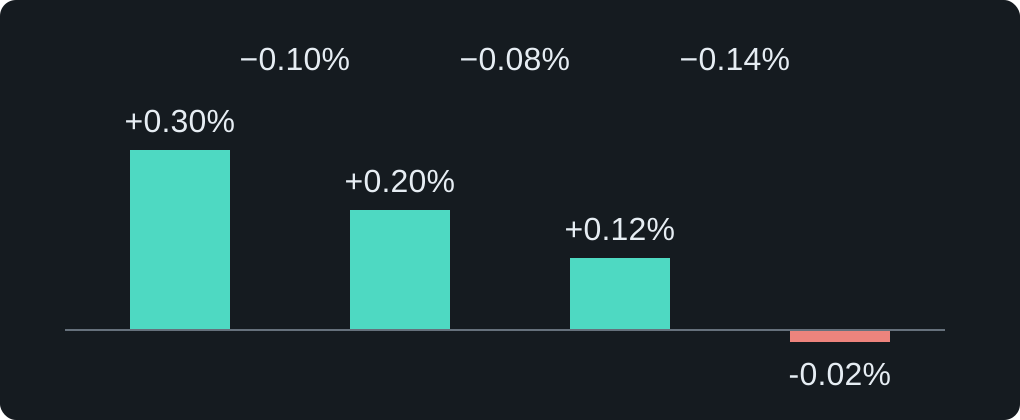
Gross result is +0.30% of a consistent position-value base. Commission is 0.05% on entry and 0.05% on exit; the spread model charges 0.08% for the round trip and adverse slippage 0.14% for the round trip.
The additive net estimate is 0.30 − 0.10 − 0.08 − 0.14 = −0.02%. These are invented figures, not any venue’s current prices.
Avoid double counting
If buys are already simulated at ask and sells at bid, the spread is included in execution prices. Do not subtract it again. Define the slippage benchmark explicitly rather than mixing all deviations from mid-price.
Actual execution prices and a separate approximate cost model must be reconciled.
A candle does not prove execution
Touching a limit price does not guarantee a fill: orders may be ahead in the queue. A market order does not guarantee price. OHLC alone cannot determine which came first when both stop and target lie inside one bar.
Show several reasonable cost assumptions rather than choosing the most favourable. See Investor.gov on fees and CME Group on liquidity measures. This is education, not a broker assessment.