SOW (Sign of Weakness) describes directional decline toward the bottom of a range or beyond it, commonly with wider bars and increased activity. Its meaning depends on context, not a candle’s colour.
What to compare
Assess distance, closes and recovery attempts. When support is crossed, distinguish a brief penetration from developing movement below it.
High volume without meaningful downward progress needs separate interpretation. Not every volume surge proves weakness.
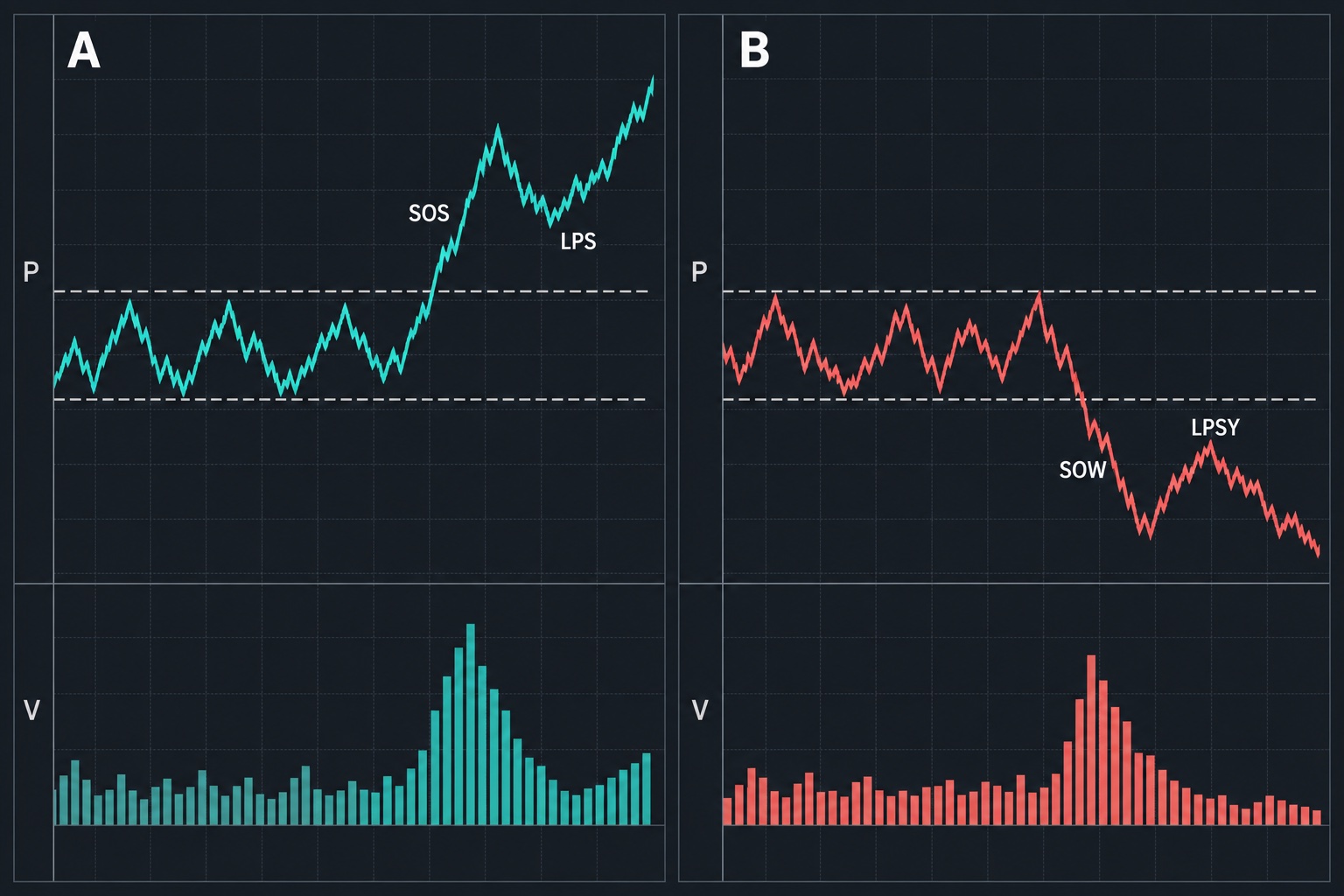
Hypothetical sequence
Earlier declines in a 100–110 range held around 102. A new movement reaches 98 on wider bars; the recovery restores only 100. The sequence is compatible with SOW and a possible LPSY.
Separate what was known at each stage. Later decline cannot establish that weakness was unambiguously confirmed at the start.
Counterexample: return inside
A low of 98 followed by a rapid recovery to 105, with support previously at 100, may represent a test rather than a sustained downward exit. In inferred accumulation, a spring may be considered.
The same price of 98 cannot determine the event’s name. Prior context, return and later progress matter.
Limits
SOW does not establish selling by particular large participants. State the volume source, especially for fragmented markets and tick data. Weakness on a small scale need not end the larger advance.
See Bruce Fraser’s distribution terminology. This explains observations, not a trade recommendation.