Last Price, Index Price and Mark Price are three different quantities. A crypto futures contract can display different values for all three at the same time. Before comparing a candle with a liquidation level or someone else's annotation, identify the chart's series and the reference used by the relevant exchange rule.
What each price means
| Series | What it describes | What it does not provide by itself |
|---|---|---|
| Last Price | The latest executed trade in the selected contract | A guaranteed price for the next execution |
| Index Price | A calculated reference from selected spot sources | A trade executed at that value on your exchange |
| Mark Price | The exchange's calculated valuation of the contract | A promise that you can buy or sell at that valuation |
Index constituents and mark-price methodology depend on the venue and contract. Do not apply one exchange's formula to every perpetual future. Binance, for example, links its mark price to several spot venues and other components; Kraken publishes its own definition.
One moment, three numbers
Suppose A is Last Price 100, B is Mark Price 100.1 and C is Index Price 100.2. These are three series, not three faulty measurements of one trade. Later, the last trade can be above the mark price, then below it.
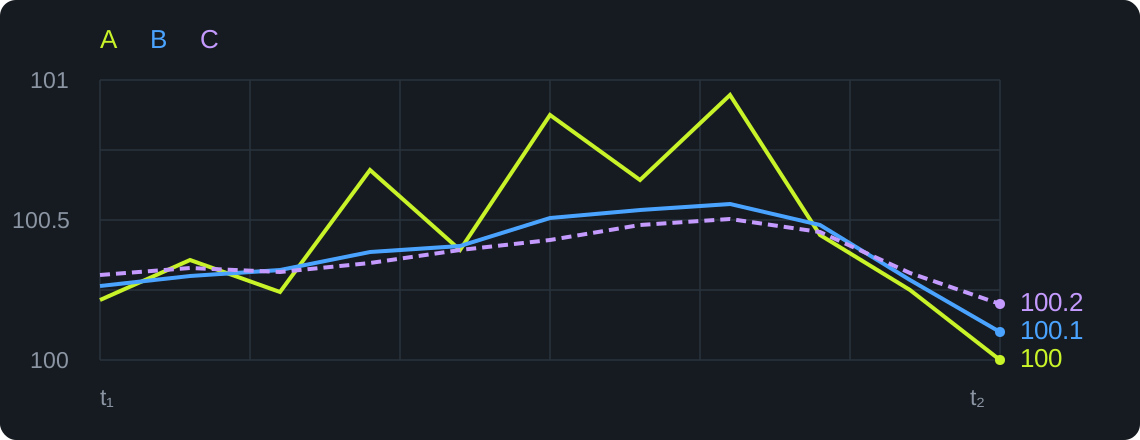
If one large trade leaves a wick in Last Price, the index and Mark Price need not reproduce it. Mark Price still changes, however: it is not fixed and does not eliminate liquidation risk.
Why liquidation and a candle's wick may disagree
Binance Futures uses mark price for unrealized PnL and liquidation checks. A Last Price chart that never touched the level therefore does not prove a liquidation error: another series was checked. Conversely, a last-price wick through a drawn level does not alone establish that liquidation conditions were met.
To investigate, you need historical Mark Price, the margin mode, collateral state and contract rules. A screenshot is insufficient. A forced-close level should not be assumed constant regardless of changes in the position and collateral.
Trigger price is not execution price
An exchange may let users choose the reference that triggers a stop order. Meeting a Mark Price condition does not mean the trade executes at Mark Price. Order type, available opposing orders and execution rules then matter.
Even Last Price describes an already completed trade, not a promise to the next buyer. A market order can fill in several parts at different prices. The distinction between a trigger, a quote and a fill relates to spread and slippage.
How to compare chart annotations
- Record exchange, pair, contract and timeframe.
- Identify the chart's series: Last, Mark or Index.
- Check the reference for alerts, stops and liquidation separately: they can differ.
- Compare matching intervals and closed candles from the same series.
Do not automatically transfer Last Price analysis to Mark Price: extremes and candle shapes can change. Not every service provides all three histories. Without the required series, you cannot establish how it behaved. For venue differences, see why crypto charts differ between exchanges.