The Wyckoff cycle is a conceptual sequence of accumulation, markup, distribution and markdown. It organizes price and volume observations, but does not require every market to pass through four clean stages on a fixed schedule.
Here “cycle” describes both the market model and the linked learning sequence.
From the model to individual events
- The method: three laws and observation versus interpretation.
- Accumulation: stopping a decline and forming a range.
- Distribution: stopping an advance and studying weakness.
- Phases A–E: different tasks, not equal time segments.
- Spring and upthrust/UTAD: crossing a boundary and returning.
- SOS and SOW: strength and weakness.
- LPS and LPSY: reactions following directional progress.
- Effort and result: comparing volume with price progress.
Four stages are not phases A–E
Accumulation and distribution are inferred processes within a range. Markup and markdown are upward and downward movement outside it. A–E describe development of a particular schematic, not five separate stages of the whole price cycle.
An uptrend can pause for reaccumulation; a downtrend for redistribution. Sideways movement alone cannot establish which process is occurring.
Reading the illustrations
Identify the previous trend and range first. Describe observable returns, wider bars and weak reactions before assigning an interpretation.
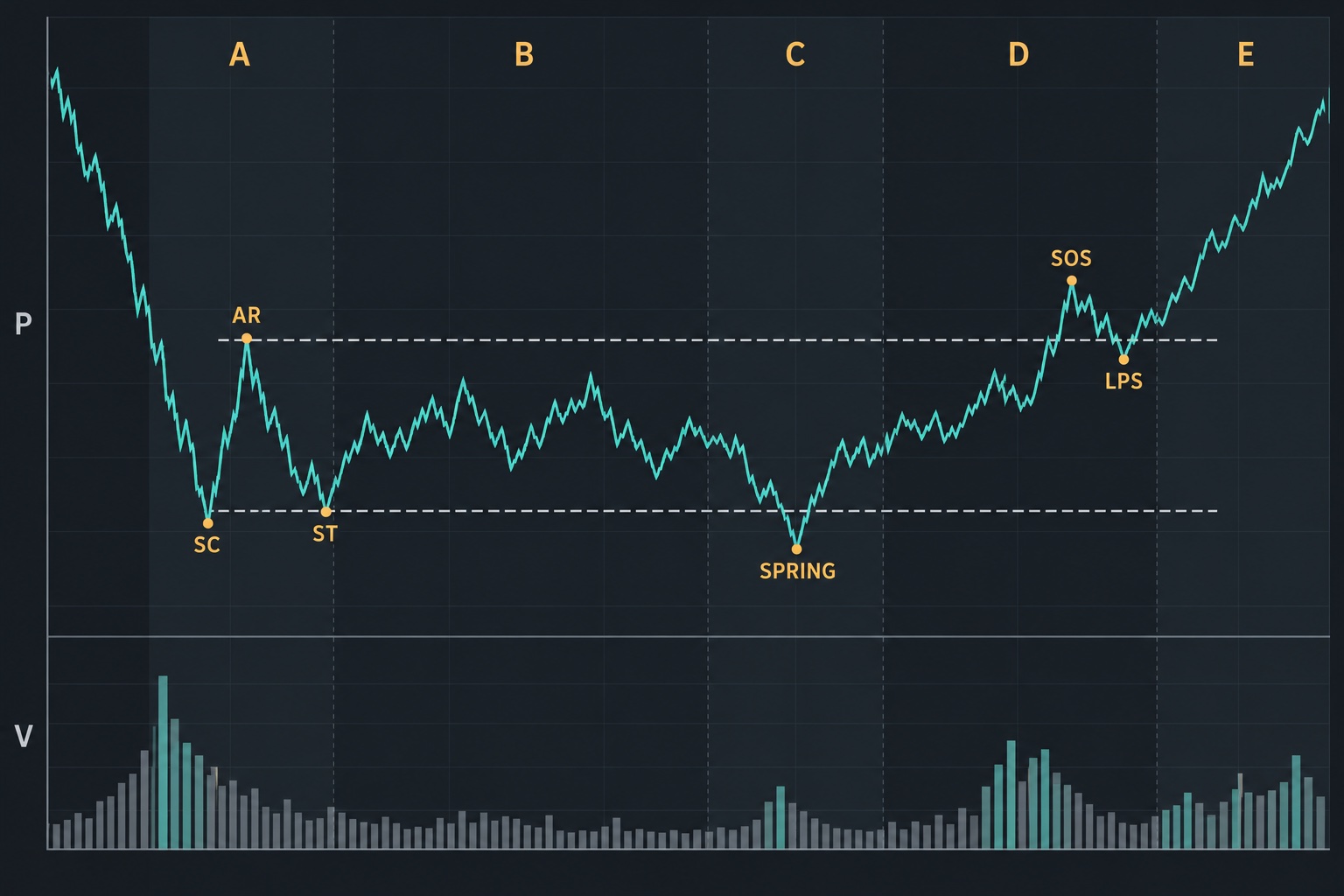
Completed diagrams are useful for teaching, but their right-hand side was unknown in real time. Cover it and record what still needs confirmation or would contradict the hypothesis.
The vocabulary is presented in ChartSchool. This course explains concepts and limits, not trade recommendations or verified probabilities.